
There are 4 major topics in this post.
- Add your own sales message to our patented “flat pack” wood displays.
- How to use the “triplicate of choice” sales technique.
- Use “reduce it to the ridiculous” to counteract price objections.
- How to use “Tactile Response” to sell higher quality locks.
Add a sales message to our Lock Blocks
Here is a template for creating your own sales message. Reproduce this idea in your own Word Processor Software. Pay attention to the dimensions, and add your own text, colors, and pricing. Print it out on good quality card stock, fold it, cut out the notches, and attach it to our Lock Blocks. Simply loosen the lockset a little bit, and slip it between the face and the edge, and tighten the hardware. There is also a template for a message that when folded correctly, will fit into the top of the display. (Of course this wont work if you glued the display when it was assembled.)

The “Triplicate of Choice” always worked for me.
I always used the “triplicate of choice” sales technique, especially with regard to residential deadbolts. It works like this. But first, some ground rules.
- Selling is never about price, it is about the value of your service as perceived by the customer. If it was always about price, everybody would drive Kia’s.
- Always show your BEST product to the customer FIRST. They came into your shop looking for advice, so you are in fact obligated to show them the best solution you have, up front.
- Always project an image of excellence and professionalism which will instill confidence in your clients mind. Remember, you never get a second chance to make a great first impression.
Triplicate of choice explained
- You will need to pick 3 quality levels of locks.
- A low level lock that you are not embarrassed to sell. It should be something they cant get at a hardware store. By way of example, this might be IDN 75 series grade 3 or better.
- A middle level lock that offers good value, AND that offers you a great margin. By way of example, this might be IDN 260 series, or General Lock D160 series
- A high security lock that offers pick resistance and key control. By way of example, this could be the D160 with an upgraded key cylinder, or the ILCO 4500 series with high security mortise cylinders, or Medeco/ASSA/Abloy, etc.
- Always show your best lock first and “bullet point” the features. i.e, UL listed, ANSI Grade 1, pick proof and bump proof, registered keys so only the owner can get duplicates, reinforced strike plate with long screws, etc, etc. Let them hold it in their hand. (See tactile selling below)
- Next show them your middle line lock and also “bullet point” the features. You will likely sell more of this lock than the other two. Most people don’t want the cheapest, and their budget may not allow for your best, so they will gravitate to the middle choice. So this should be the lock that you make the most profit percentage from.
- Lastly, show them your bare minimum lock, which will have less “bullet points” than the other 2 choices. By the time you get around to this lock, there realy isn’t a list of features, its just a lock.
- Have pricing ready to go. You should know from experience what it costs to sell and install the lock as a bundled price. For example, your best lock might be $250 installed, the middle lock $150 installed, and your #3 choice, $75 installed.
- Dont offer all prices right away. Offer the #1 lock price first. Only offer the #2 price ONLY if they ask, and the same with your #3 lock.
- Once you have quoted them a price – STOP TALKING & SHUT UP – your silence applies subtle pressure. This is a golden rule of sales and negotiation, the first guy to speak, “loses”. Wait for them to counter your proposal with an objection, and then deal with the objection. If it is price related, see “reduce it to the ridiculous” below.
- Get a deposit from them. This helps prevent “second thoughts” after they leave the shop.
Reduce it to the ridiculous.
- When you get a pricing objection, try reducing it to the ridiculous. For example, if your best lock is $250 installed, you could point out that if they stay in the house for only 5 years, that’s only $50/year or about $4/ month or .15c per day to own the very best lock money can buy.
You can apply the “triplicate of choice”, “show the best first”, and “reduce it to the ridiculous” for anything you sell. In fact, if you listen closely, you may hear it being done to you! For example, I recently joined a fitness center and the sales person led off the presentation with their best plan for working with a trainer and monitoring my diet. I had to start asking questions before I found out there was a “middle plan” which was better for me financially.
Using Tactile Response to Sell Product
You will need a few of the LocksetBlocks “See Thru” clear plastic sleeve mounts to perform this demonstration.
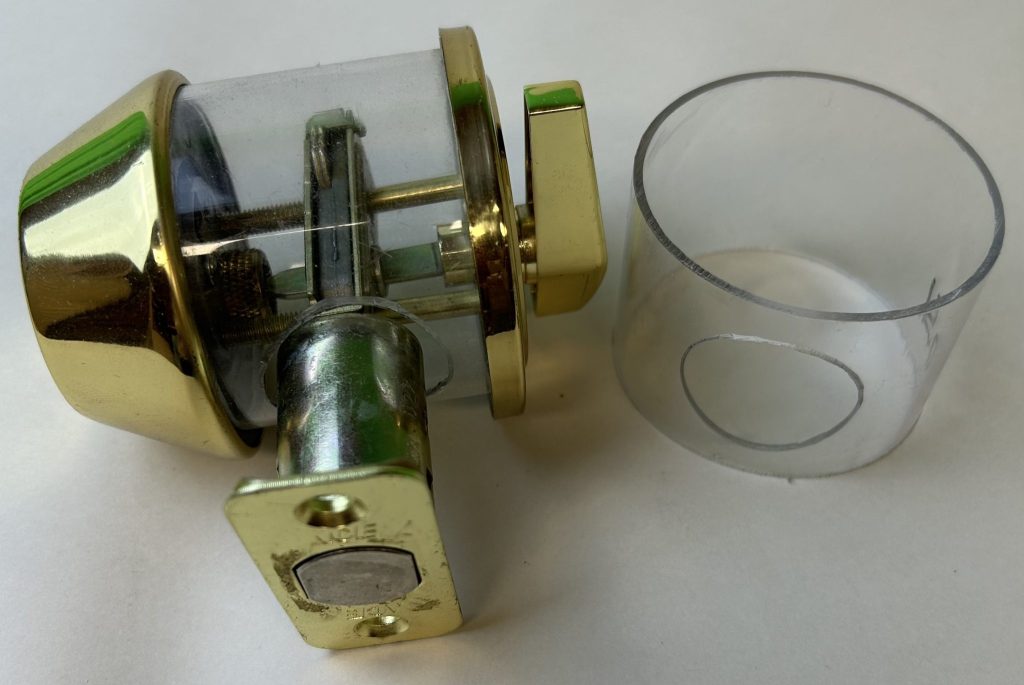
- Hand the client a “typical” hardware store brand lock already assembled in the See Thru sleeve. This allows them to hold a complete lock assembly safely in their hand (tell them to notice the weight), and they can also see the mechanism that would ordinarily be hidden inside the door.
- Next, hand them the lock you are recommending. It should be a LOT heavier that the hardware store brand, and the inside mechanism must be noticeably more robust than the hardware store brand. The client will immediately notice the extra weight, and equate that with better quality. Be sure to point out the construction differences that would usually be hidden inside the door.
You can demonstrate this by using a Defiant or Reliabilt budget brand lock (from the big box stores), compared to something like a General D660 or D160, or a LSDA 220 Series. The client will usually go for the “heavier” product and realize that they are getting more value. This was one of my favorite things to do when talking to a client about new locks.
Questions?
Did this work for you? Leave a comment!
Let me know if you need help!